The Revolution Continues blog is news, views, opinion and other expressions of hope from a leftist point-of-view. (We are not affiliated with any candidate, political party or organization. All are welcome.)
Showing posts with label universal healthcare. Show all posts
Showing posts with label universal healthcare. Show all posts
A system that
makes you pay to exist, compete to eat, and obey to survive is not a
civlization; it's a prison with shopping privileges. —Anonymous
Round Peg Revolution
by C.A. Matthews
There’s an old saying that goes, “You can’t fit a square peg into a round hole.” When I saw the above meme, I was momentarily taken aback. In this instance it’s the “round pegs” telling the “square peg” that they’re not going to change to fit the “square hole” or system. The round pegs insist that it’s better if the system is changed to fit all pegs. No peg is left behind that way.
Wow. That’s pretty deep, isn’t it?
What is the “system” these pegs are talking about? Could it be the system of government or a political system the pegs live under? Could it be the economic system the pegs have to work in? Could it be the social system that dictates what is considered moral and what isn’t in peg society? Could it be all three?
For ease of argument, let’s say the pegs’ “system” includes all three dimensions—social, political, and economic.
Now notice the square peg’s countenance and gesturing in the meme. It's frowning and pointing. Its demeanor is disapproving and demanding. The square peg is shown carrying a briefcase—sure evidence of a closed mind if there ever was one!
I’ll admit I’m jumping to conclusions with the scanty facts presented, but you’ve got to admit that any peg which has sharp corners, carries a badge of honor for business-types (the briefcase), and displays a stern, condescending attitude toward others who are different from it is probably not a very nice peg person.
I believe the technical term for this type of peg would be an “asshole.”
The round pegs, on the hand, seem friendly and outgoing. They’re willing to work with the square peg to build a better system—a better world, you could say. Their willingness to think outside the box—or rather the “square hole”—and include a wide variety of pegs in their system demonstrates flexibility and their ability to handle a greater range of experiences. They’re not stuck with four sides and four corners. They’re “fluid” not “rigid,”open to change and desiring that all pegs thrive in their system.
Square peg with its briefcase and finger pointing tells us that it’s “The square pegs’ way or the highway!” The square peg system is unyielding. All pegs must re-shape how they think, how they act, who they are, and what they do to survive in order to fit into the square peg system. There are no options, no consideration for individual differences, talents, or tastes apparently in a square peg world.
To find out more about the differences in the "peg systems," continue reading the rest of this
article on Substack. You can do so by copying or clicking on this link:
There you'll see related article and video links, all the graphics, and
be able to leave comments. You can become a free or paid subscriber and
receive weekly posts in your email box, along with occasional special
articles just for paid subscribers, too.
This
article is the 520th blog posting of The Revolution Continues. We began
in June 2015, and we're still going strong. Please keep reading,
sharing, and subscribing to help TRC continue for another ten years.
No doubt, it will be called the surveillance video of the century. Well, no one who is working class—or even upper middle class or whatever is the term for those who aren’t quite in the top one-percent of earners in the US—is going to forget it. If you have ever paid private health insurance premiums, co-pays, and deductibles, or filed for bankruptcy because of medical debt, or if you or your loved ones have ever been denied necessary health care by a private insurance company, then you will understand why so many are cheering over the gunning down of UnitedHealthcare CEO Brian Thompson on a Manhattan sidewalk.
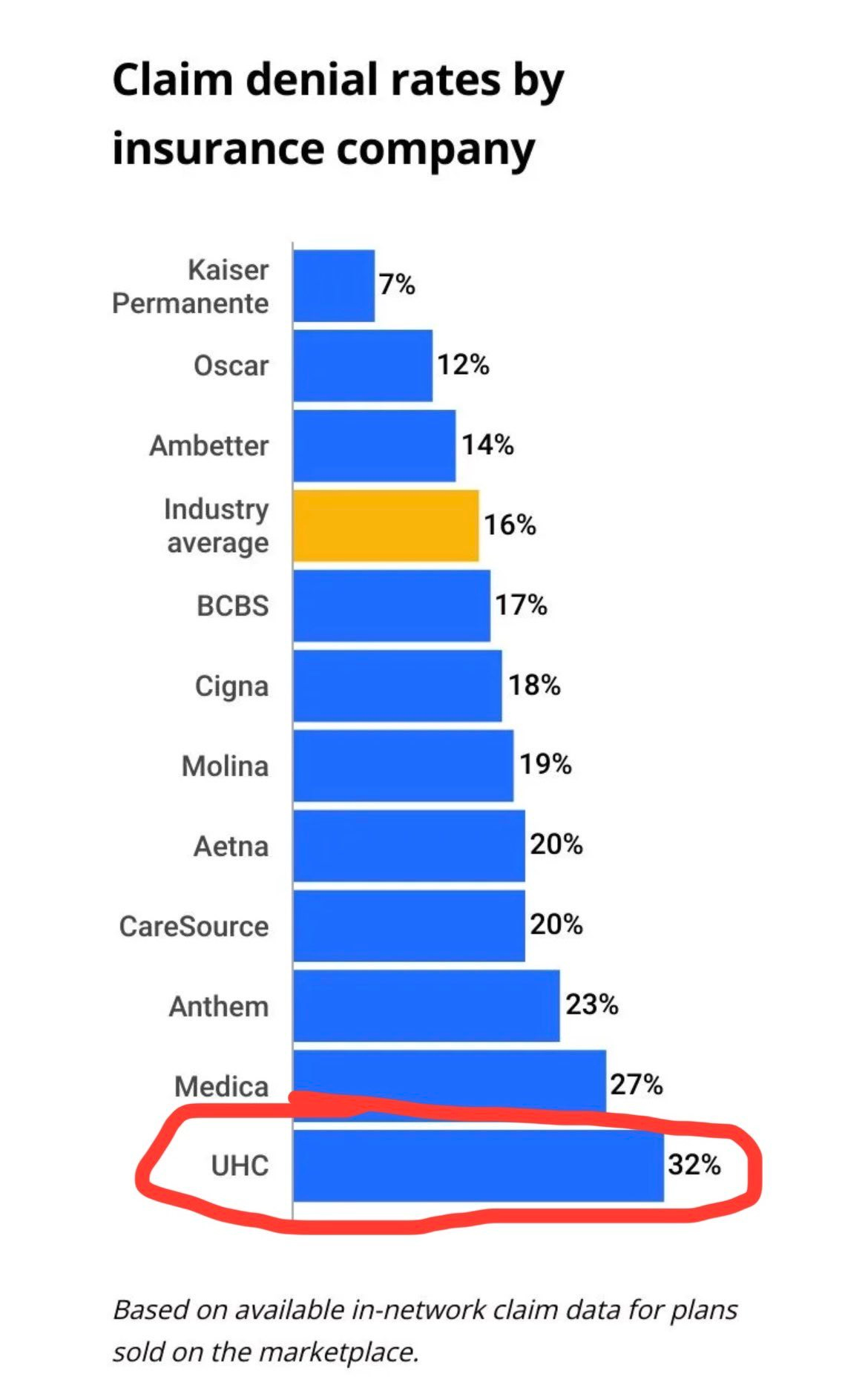
Thompson was a man already under suspicion of insider trading by the Department of Justice, a man who made well over $10 million yearly, a man whose estimated net worth was estimated at approximately $42.9 million as of February 16, 2024, according to Wallmine.com, and a man whose corporation, UnitedHealthcare, has become notorious for its 32% denial of claims, with a market cap of $561.15 billion, the world’s 16th most valuable company by market cap according to CompaniesMarketcap.com.
So, yeah, it couldn’t have happened to a “nicer” guy.
The internet is full of some of the best memes and quotes ever this week. The shooter is being called the “Adjuster” by some, since he acted as a “claims adjuster” of sorts. The upside of all this hullabaloo is that after a lull we’re once again seeing a familiar hashtag: #MedicareForAll
It doesn’t seem all that long ago that I was actively volunteering for a presidential candidate who touted Medicare For All...
To learn who this candidate was and more about the sickness of capitalism, please read the rest of this article by clicking on this Substack link: https://therevolutioncontinues.substack.com. There
you'll see related article and video links, all the graphics,
and be able to leave comments. You can also subscribe and receive the
weekly blog post in your email box.
Subscribe to The Revolution Continues on Substack today! Power to the people!
Most
of us can remember our “first, real paying job.” For Americans,
we were most likely in high school, and a classmate mentioned to us
between classes how their boss was looking for more summer workers
and that we should apply and make some money. I had been babysitting
for our neighbors since I was about twelve years old, but it was very
hit and miss work, and there was a lot of competition on our street.
This was my chance to enter the “real paying job world” at age
sixteen. I road my bicycle a couple of miles from my home to
interview and got the gig. I worked a long,
hot and stormy summer standing
on my feet for eight hour shifts in
a soft-serve ice cream walk-up stand along Main Street and made the
huge sum of $1.25 per hour for about 32
hours of work per week.
Hard to believe $1.25 an hour was considered "good pay,"but that was the state’s minimum wage for “tipped employees” at
that time. All restaurant workers were paid that amount hourly. It didn’t
matter that we didn’t get tipped making ice cream cones for folks
who walked up to the window. We
were still
considered
“food service workers” and paid that lowly wage. I worked hard
that summer and ended up getting a raise—a
whole
$1.35 per hour.
Wow.
I thought I’d had it made.
The
next summer, a friend told me about a job working at a warehouse
clearance
sale
for a national franchised dress shop located in our local “mall,” a
newfangled place built on the east side of town and not located
downtown where a few of the big
department stores were
still
to be found. I
was
overjoyed
when I heard what this job paid—a whole $2.35 an hour! It was the
federal minimum wage. It was what older people made working similar
jobs, so I really felt like an adult at age seventeen. Even though I
spent a lot on clothes with my employee discount of 10% off that
summer, I saved a bit of money that I later used to get ready for
college.
Almost a
half century and many jobs later, the federal minimum wage hasn’t moved
upward all that much when adjusted for inflation. For the past
fourteen years, the federal minimum wage has been stuck at $7.25.
But
why? Corporate profits are up practically across the board or so we’re told
on the nightly news. CEOs get huge bonus packages. “Bidenomics is working,” neoliberals insist.
What’s wrong with us if we’re struggling to get by in the midst
of all this “booming economy” we’re told exists in the US
today?
Maybe
it’s not us who are wrong about the reality of our situations.
Consider
this:
The
federal minimum wage in the United States would be more than $42 an
hour today if it rose at the same rate as the average Wall Street
bonus over the past four decades, according to an analysis
… by the Institute for Policy Studies.
Citing newly released data
from the New York State Comptroller, IPS noted that the average Wall
Street bonus has increased by 1,165% since 1985, not adjusted for
inflation.
Last year, the average cash
bonus paid to Wall Street employees was $176,700—75% higher than in
2008 but slightly lower than the 2021 level of $240,400.
The federal minimum wage,
meanwhile, has been completely stagnant since 2009, when it was
bumped
up to $7.25 from $5.15. While many
states and localities have approved substantial pay increases in
recent years, 20
states have kept their hourly wage floors at the federal minimum.
So,
where’s our $42 per hour? I
guess it’s in
the same place where
our $600 went when we were promised $2,000 COVID relief checks when
Biden took office, but
we
only
received $1,400, right?
What’s
a working stiff in the US to do? We
can’t even afford to rent an apartment anywhere in the fifty states working
full-time hours (if you can get them) at $7.25 an hour. There have
been talks and protests centered around raising
the federal minimum wage to
$15
an hour, but
can anyone even afford to rent a decent place to live on that amount?
It’s doubtful. Not
even a $25 minimum wage can help a family rent a home in many cities.
American
workers
do have one
powerful option, but it’s rarely been discussed since Reagan took
office. We have the
ability to strike—if we’re not forbidden
to do so by federal law, such as the case with railroad
workers or air traffic controllers, that is. But so many Americans have been
brainwashed into thinking that a strike will cost them their job and
their health insurance, so they simply won’t
consider
it.
Are
Americans cowards? Not necessarily. I’d say we’re realists. We
know
we have
no safety nets like workers
in other
countries who
are blessed with
universal health care and universal basic income or "UBI" payments. With
no way to provide for our families without our lousy paying jobs,
we’d
best stay put and put up with the harsh treatment of the bosses.
But
are strikes really all that risky for workers? Where
did we get this idea that we the working class are essentially powerless and only billionaires can get what they want? Consider
this:
The
Teamsters Union and UPS have reached a tentative
agreement
on a new contract to cover the 340,000 Teamsters who work for the
package shipping giant.
According to a statement
released by the union, the new contract is “the most historic
tentative agreement for workers in the history of UPS,” promising
wage increases, an end to the two-tier wage system, new air
conditioning in vehicles, Martin Luther King Jr. Day as a full
company holiday, and more.
In the days and weeks to
come, members will debate the pros and cons of the proposal as
thousands of UPS Teamsters vote on whether to ratify the contract.
But one thing seems undeniable: Any significant gains won by
Teamsters against a reluctant employer will have come about because
rank-and-file workers showed the company that they were prepared to
strike.
I
put
that last sentence in italics for emphasis. It bears repeating: Any
significant gains won by Teamsters against a reluctant employer will
have come about because rank-and-file workers showed the company that
they were prepared to strike.
Rank-and-file
workers actually have power? Yes,
we do!
Even the possibility of a strike can motivate a reluctant employer to
sit down and discuss the workers’ grievances and demands. And
if push comes to shove, the workers walk out and give the employers
even more to worry about as the company's profits take a hit and its reputation as being a fair and honest employer is thrown into the dumpster.
Fourteen
years of a stagnant federal minimum wage (with no maximum
wage for billionaires set) and no universal health coverage for all Americans should be a wake up call even for the sleepiest of workers.
Our government doesn’t work for us, the people, but for those who
already have more than enough wealth and power and obviously don’t
give care one bit about how many workers can’t even afford to rent an
apartment or put food on the table for their families. Our government
doesn’t care if we or our loved ones get sick, and we have no way
to afford medical care other than to beg strangers for donations via
GoFundMe.
Face
it, America. It’s time to lose the blind loyalty to both your
employers
and to
our
government. They
don’t have our best interests at heart. And we have the power to
make them see things our way—strike!
RBN's Labor Organizing Summit Part 2 Livestream -- featuring Kshama Sawant. I sat on a panel with other Green Party members and former presidential candidate Dr. Jill Stein. (It starts at approx. 3:02 and the video should start there.) Hear what I and other Greens have to say about the labor situation in the US currently. (The answer to many of our troubles is to "Go West!")
Coming soon, the first book from The Revolution Continues blog: The Little Red Book of Revolution
How can you get your e-copy? The easiest way is to subscribe to The Revolution Continues on Substack as a paying subscriber. Choose what level you'd like to subscribe at via the buttons on any post online at: https://therevolutioncontinues.substack.com